I am a quilter living in Woodbridge, Suffolk who has made quilts since I was a teenager. I also ring bells! Both are great British traditions....I will try to feature some of my antique Welsh and Durham quilts, the quilts I make myself, my quilting activities and also some of my bellringing achievements. Plus as many photos as I can manage. NB: Double click on the photos to see greater detail, then use back button to return to the main page.


Thursday, 16 May 2013

Another Red Paisley Welsh Quilt...


Yes, I have quite a soft spot for these red paisley quilts...the fabrics are so lively and warm...I also know that the process to make Turkey Red was a complex one. I'm not sure that it is possible to buy true Turkey Red any more .... and that certainly most of the repro fabrics look nothing like the original colour, which is a bright red.

This quilt was made for a bride's bottom drawer and seems never to have been used, as it is unworn and the colours are bright and unfaded. It seems to have a worn blanket as it filling, and the quilting is correspondingly coarse. But, the general Welsh format is still followed, as there are borders and a circular central "coin".


The borders have a large diamond quilting pattern...


...and the centre has a circular pattern. I may try to trace this to see what it looks like...it is hard to see, given the background patterns of the fabric.


Two different paisleys fabrics are used....more quilting. This is done in a heavy thread (in yellow and also red) which is almost like an upholstery thread.


Snowy, trying to get in on the act...


The top has this pattern, unfaded with plenty of yellow, green and blue. Although the Turkey Red stands up well to time and wear, the other colours do fade, and eventually just red white and a bit of yellow are left....its nice to be reminded just how colourful the fabrics originally were....

The reverse fabric is a darker red with a large "pod" or paisley pattern. Again, lots of colour here.

This quilt dates from before 1900. It belonged to the seller's grandmother, Blodwen Stephens, maiden name Morgan.She lived all her life in and around Llanelli. This area had many professional quilters, so Blodwen probably didn't make it herself. What a lovely quilt!

Monday, 13 May 2013

Walk at Tattingstone on May Bank Holiday

For our usual weekly walk, we went to Tattingstone and Stutton on the bank holiday Monday. Here is Tattingstone church - this tower had five bells and then was augmented to six with a spare bell. This was done by local volunteers. Unfortunately, the new bell is almost the same note as the second, giving the ring a very odd sound - hence the nickname "Tatty" bells. Moving one's eyes right along the horizon, one can see what appears to be another church...
...this is the "Tattingstone Wonder", a folly. It was built in 1790 by Edward White, who lived at the nearby Tattingstone Place. The story goes that he wanted to see a church from his house windows. He said that "People often wondered at nothing, so he would give them something to wonder about".


The folly looks like a church, having a tower and flint rendering, but is actually three workers' cottages that were disguised to look like a church.

From the back of the house one can see that the so-called tower is actually a built up chimney stack. The folly is now a grade II* building and has been converted into a single residence.


The garden of the Tattingstone Wonder - I liked the old car, the greenhouse and the childs bicycle....


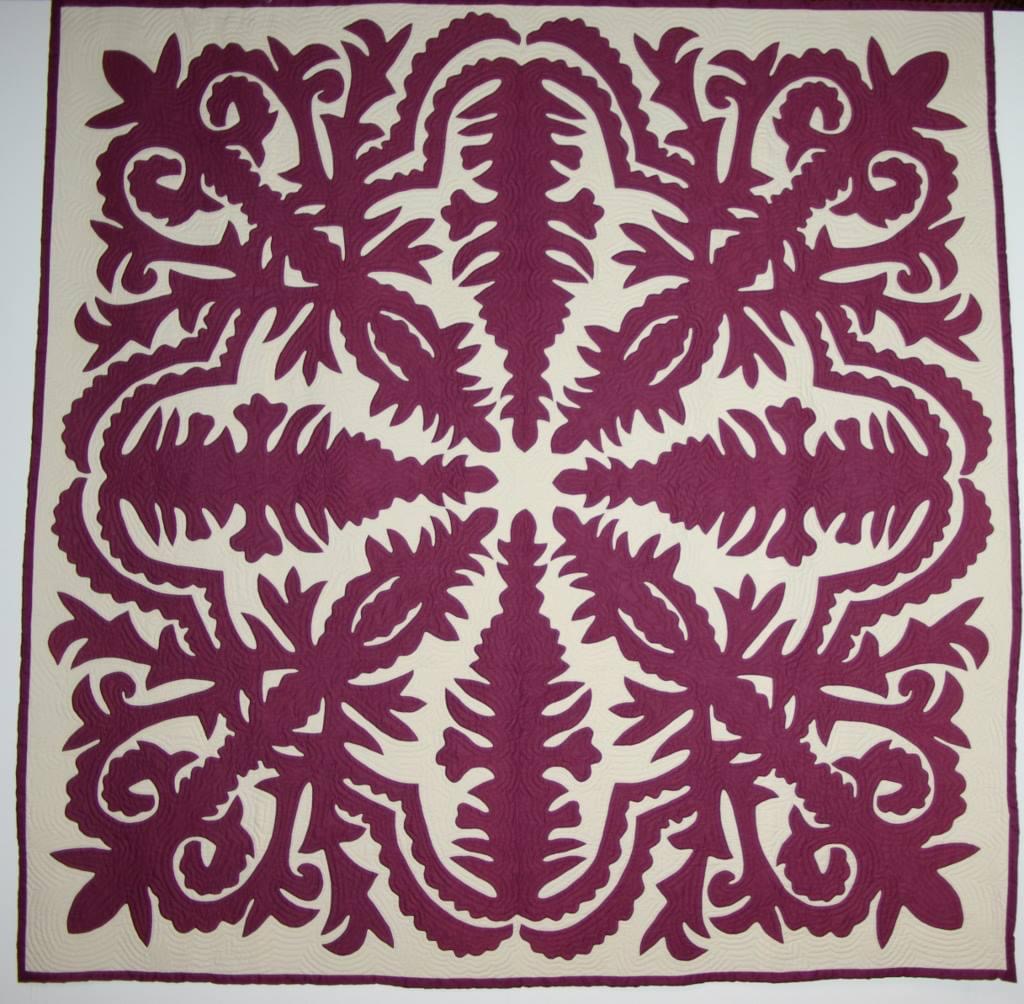
...and finally Snowy, found sleeping where she should not be....my Hawaiian applique in its Ikea bag!

Friday, 10 May 2013

Fabric Sample Books from Dunfermline, Scotland

I recently bought three sample books, which were City and Guilds entries. It seems as if someone was working in a weaving factory and also getting qualifications at the local college for weaving.


None of the folders are dated!! But this one was also entered into a competition and won the first prize of £20. I guess that's why it was kept, someone was very proud of this prize...


Not dated, but there is a name Alexander Kinnell of Deanston, Doune in Perthshire (Scotland) and studying at Lauder Technical College in Dunfermline.


The samples are all of various linen and linen mix fabrics...


....and are furnishing and dressmaking fabrics. Looking on the internet, I found that Dunfermline was a centre of damask linen weaving from 1709. After WWI this type of heavy fabric, which was used for furnishing, tablecloths, serviettes and the like, became unfashionable and the industry declined. Man-made fabrics started to take over. By 1933 there were only three damask factories in Dunfermline. By 1986, only Erskine Beveridge was still producing, although cotton damask, not linen. It shut in 1989. The other two firms were Reids Hay and Robertson and Winter Mier.

So it is my guess that Mr Kinnell worked for one of these three firms after WWII? More research could tie it down a bit more...interesting to see what was produced, there are also diagrams showing the loom set ups; the production of fabric is much more complex than I had realized!

Tuesday, 7 May 2013

Welsh Centre Diamond Quilt...Very Worn...

Here is another Welsh quilt that I bought recently. It is very worn, so is a study or display item......it did not cost much.....only £10....


I like these geometric patterns. These were obviously to use up remnants of fabric that were available. Wales as you know was a very impoverished area....This quilt is made of damask or brocade type fabrics, the wadding is wool. I will have to look with my microscope at the fabrics to determine whether they are woollen or cotton.....
The stitching is interesting although crude, due to the thickness of the fabric...the photo doesn't show it very well, but there is a lot of bearding, where the woollen fibres have worked their was through the surface fabric, giving a whitish cast.

Another look at the centre!!

The back is a similar green brocade to the front, and the back is very worn .


In places, the fabric is worn away in areas that stood "proud". The quilt must have been very well used over the years.


A strange thing...there seems to be a cotton backing fabric inserted under some of the more worn areas ....was this an attempt at repair, or was the fabric already thinning in some areas when the quilt was made?

This quilt is all hand pieced and hand quilted. It could be an earlier quilt, or perhaps the family did not have a sewing machine....

I received a very nice note from the seller (from Swansea) who said that she had bought the quilt at auction 30-40 years ago, she knew that the quilt had been passed down in one family and thought it might be from Pembrokeshire. She had thought to cut it down and make it into a wall hanging, but used it as a table cover and then later hung it over a banister before recently moving to a smaller house.

This quilt ties in very nicely with the "Amish Connection" and Dorothy Osler's book on the subject.

Friday, 3 May 2013

Soldier's Quilt from Ontario, Canada


Here is another quilt that I bought recently - I think that it is another WWII Red Cross quilt, although it was bought as a "soldiers quilt".


There is a label, but it is not the ususal Red Cross label; it shows that the quilt was sent from the Mitchell and District area of Ontario Canada, from "War Services".

The quilt is unusual in that it is more carefully made that many of the Red Cross quilts that I have seen, it is all hand pieced and hand quilted. My guess is that is was an older utility quilt that was donated to the war effort, and not specially made. As you can see, it is a four patch with star block, and  is very worn in some parts.


There is also a tie sewn to the quilt (by machine, quite crudely) and also a loop sewn to the binding, I suppose that this is so the rolled or folded quilt could be tied into a bundle.

I posted photos onto and online group of American quilt experts, they confirmed that the fabrics dated from 1890 to 1900. I will again be giving this to the Red Cross Study Group, if they will have it.

Saturday, 27 April 2013

Jen Jones' Quilt Shop in Llanybydder - Video Tour


Here is a lovely tour of Jen Jones' quilt shop in Llanybydder, Wales....given by Jen herself. It gives a good flavour of the atmosphere in this wonderful shop. Quilts and also Welsh blankets are discussed...enjoy.....

Sunday, 21 April 2013

Trip to Bury St Edmunds

A trip to Bury St Edmunds was on the cards today, as Mike had been invited in to a quarter peal of Grandsire Cinques at the Norman Tower today.


This was once a very prosperous Abbey - then after the Dissolution it became the Church of St James - now it is a cathedral, with a new Millennium spire...very pleasant Abbey gardens...

 ....but first, we had a little adventure on the motorway, the A14...we came across a horse box that had broken down - one girl was staying with the truck while the other walked off to find some diesel - we gave her a lift, found a petrol station that was open, and returned to the truck...only to find that the police were in attendance. We left, feeling sure that the girls (and horse) would be on their way shortly...

 Here's Angel Hill, with the Gatehouse and the cathedral in the background.

 The church has a detached bell tower, the so-called Norman Tower (thus very old even by English standards). The quarter peal attempt didn't last very long, as there was a problem with the fifth bell. The stay was poorly cut and was not engaging with the slider properly...We went up to see the bells, very interesting.....

My talk yesterday went very well and was well received. Thank goodness that the hall has good accoutics and a microphone was not needed. Got through all the quilts, altho I had to hurry a little at the end! Quite a few were interested in the Ruth McDowell pieced flower quilts and my Hawaiian quilts. Anne Bevan put in a good plug for BQSG. And the Benefactors appeal was announced by the co-ordinator. Here is the first speaker, Clive Barnett who talked about his City and Guilds work, and showed dyed and overprinted fabrics.